
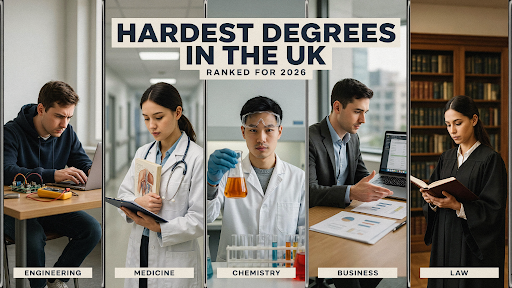
Choosing a degree because it sounds prestigious can become expensive once the workload arrives. The hardest degrees in UK universities usually combine dense theory, difficult assessments, independent study, practical training, or professional standards across several years.
No official British ranking declares one course universally the hardest. This list compares the hardest degrees in UK study through conceptual depth, workload, assessment pressure, practical requirements, course length, and consistency.
Students tackling demanding briefs can use university assignment support for planning, structure, research direction, and reference-based guidance while keeping their module rules in mind.
What Makes the Hardest Degrees So Demanding?
The hardest uni degrees feel difficult in different ways. Medicine stretches memory and clinical judgement, physics demands abstraction, architecture creates project pressure, while law turns extensive reading into tightly argued answers.
The 2026 Student Academic Experience Survey reports 15.5 weekly contact hours and 11.1 independent-study hours for full-time UK undergraduates. Students in paid work face average combined commitments of 44.2 hours, so time pressure matters.
When students ask what the hardest degrees are, five factors repeatedly matter:
- Conceptual depth and cumulative knowledge.
- Laboratories, placements, studios, clinics, or major projects.
- Assessment intensity and compressed deadlines.
- Research and referencing requirements, including subject-specific referencing style guides.
- Course length, accreditation, and professional competence.
The UK university grading system adds pressure because demanding modules still require consistent performance across coursework and examinations. The hardest degrees in the UK therefore test stamina alongside subject knowledge.

How We Ranked the Top 12
This is an editorial comparison, rather than an official league table. Searches for the most difficult degrees frequently mix academic difficulty with admissions selectivity, while this ranking focuses on studying and completing each course.
| Rank | Degree | Main Source of Difficulty |
| 1 | Medicine | Clinical knowledge, placements, long training |
| 2 | Dentistry | Precision, clinical work, biomedical science |
| 3 | Veterinary Science | Multi-species medicine, practical training |
| 4 | Engineering | Advanced maths, design, technical projects |
| 5 | Architecture | Studio workload, design, technical reasoning |
| 6 | Physics | Abstract theory, maths, laboratory work |
| 7 | Mathematics | Proofs, abstraction, cumulative concepts |
| 8 | Biochemistry | Molecular science, labs, data analysis |
| 9 | Chemistry | Theory, experiments, quantitative work |
| 10 | Pharmacy | Pharmacology, chemistry, clinical application |
| 11 | Computer Science | Algorithms, coding, systems, debugging |
| 12 | Law | Reading, case analysis, legal argument |
The top 5 hardest degrees lean towards clinical and professionally regulated study. Every course here remains among the hardest degrees in UK higher education because gaps in foundational knowledge tend to surface quickly.
The Top 12 Hardest Degrees in UK Universities
1. Medicine Degree
The Medicine hardest degree UK debate starts with volume and responsibility. A Medicine degree combines biomedical science, clinical reasoning, placements, communication, and repeated assessment across standard-entry programmes commonly lasting five or six years, as current UCAS 2026 medicine listings show.
Medicine ranks first among the hardest degrees in UK universities because students must apply knowledge safely in supervised clinical settings. Memory, judgement, professionalism, and patient-facing skills develop together.
2. Dentistry Degree
A Dentistry degree combines anatomy, pathology, materials science, patient communication, and fine clinical technique. Dentistry hardest degree discussions often focus on precision because scientific knowledge and controlled practical performance are assessed together.
Clinical work sits beside written assessments and case-based learning. This keeps dentistry prominent in UK searches for the hardest university degrees in professionally regulated healthcare.
3. Veterinary Science Degree
A Veterinary degree covers anatomy, pathology, pharmacology, diagnostics, surgery, and animal welfare across different species. Veterinary Science hardest degree comparisons often underestimate the breadth of knowledge needed before clinical reasoning becomes reliable.
Practical training adds another layer because students must move from scientific principles into genuine clinical situations. Sustained preparation matters throughout the programme.
4. Engineering Degree
Engineering hardest degree UK; searches usually point towards mathematics, mechanics, electronics, thermodynamics, programming, or systems. An Engineering degree also includes design projects, laboratories, technical reports, teamwork, and calculations requiring clear justification.
The hardest degrees in UK STEM study are cumulative. Weak mathematical foundations tend to create larger problems when later modules build directly on earlier methods.
5. Architecture Degree
An Architecture degree blends design judgement, technology, history, sustainability, visual communication, research, and presentation. Architecture hardest degrees; discussions often centre on studio projects developed through drafting, critique, modelling, and written justification.
The 2026 QAA Architecture Subject Benchmark Statement describes architecture as spanning the arts, sciences, and humanities, bringing creative and analytical approaches together through twelve overlapping knowledge areas.
Contextual architecture assignment support can help students organise precedent research, design analysis, and written coursework when several project components converge near the same deadline.
6. Physics Degree
A Physics degree advances into mathematical modelling, quantum theory, electromagnetism, thermodynamics, and laboratory work. Physics hardest degree arguments usually centre on abstraction because students must understand both the equation and the physical model.
That combination keeps physics among the hardest degrees in UK universities for students comfortable with formula practice who encounter difficulty when problems become unfamiliar or open-ended.
7. Mathematics Degree
A Mathematics degree moves into proof, analysis, algebra, probability, statistics, and rigorous definitions. Mathematics hardest degree; discussions become more realistic once students encounter abstraction that cannot be handled through memorised school methods.
Small misunderstandings can follow students into later topics. Mathematics therefore remains among the most challenging subjects for UK students who prefer applied examples over formal reasoning.
8. Biochemistry Degree
A Biochemistry degree combines molecular biology, chemistry, genetics, cell processes, laboratory methods, and data interpretation. Biochemistry’s hardest degree concerns often appear when students must explain experimental evidence alongside complex molecular mechanisms.
Scientific reports also demand accurate methods, results, discussion, and source use, placing biochemistry among the hardest degrees in UK life-science study.
9. Chemistry Degree
A Chemistry degree mixes physical, organic, inorganic, and analytical chemistry with laboratory work. Discussions about chemistry being the hardest degree often focus on the speed at which reactions, spectroscopy, calculations, safety, and experimental interpretation appear together.
Practical preparation and clear scientific writing matter as well. Chemistry remains one of the more demanding subjects across STEM.
10. Pharmacy Degree
A Pharmacy degree brings pharmacology, medicinal chemistry, therapeutics, formulation, law, and patient-facing knowledge into one programme. Pharmacy hardest degree searches reflect the quantity of scientific detail students must recall and apply safely.
Assessment can move from mechanisms and calculations into clinical scenarios. The hardest degrees in UK healthcare commonly demand accurate application throughout practical and written work.
11. Computer Science Degree
A Computer Science degree covers algorithms, discrete mathematics, operating systems, databases, networks, complexity, software engineering, and programming. Computer Science hardest degree discussions often grow louder when theoretical modules arrive alongside substantial coding projects.
Large submissions expose weak planning because code, documentation, testing, and explanation must function together. Computer science remains among the hardest uni degrees for students relying mainly on coding practice.
12. Law Degree
A Law degree demands sustained reading, case analysis, statutory interpretation, structured writing, and precise authority. Law hardest degree comparisons become convincing when problem questions require students to identify issues and apply legal principles accurately.
OSCOLA and module-specific source rules can make citations detailed. Students can use contextual law assignment support for case-based structure, while the Harvard referencing resource helps with modules using author-date systems.
The hardest degrees in UK universities extend beyond this top twelve. Economics, neuroscience, aerospace engineering, nursing, and several other courses can feel equally demanding when their assessment style clashes with a student’s strengths.

Hardest Degree in the World: Is There a Real Answer?
There is no defensible single hardest degree in the world. Course design, professional regulation, teaching style, assessment, personal aptitude, and university expectations vary too widely for one universal ranking.
One student may thrive in engineering and struggle with legal reading. Another may enjoy case analysis and find laboratory uncertainty much harder, which is why lists of hardest degrees work best as structured comparisons.
Hardest Degrees and Dropout Risk
Hard courses can still retain students well. Entry standards, student support, finances, placements, commuting, paid work, health, and course fit all influence continuation, so course difficulty alone cannot explain who leaves.
This matters when comparing the hardest degrees in UK education. Course intensity describes the academic experience; continuation reflects a wider set of student and institutional factors.
How to Handle a Demanding Degree More Efficiently
Start with the assessment calendar. Map examinations, reports, placements, studio reviews, group submissions, and reading weeks early, then work backwards from the heaviest deadline clusters.
For written work, practical steps for writing a university assignment in the UK can help with command words, structure, and evidence. Proofreading and editing support can also help clean up an existing draft before final review.
Academic support is most useful when it helps students understand tasks, organise research, improve structure, and apply feedback. University academic-integrity rules should remain the final authority on permitted assistance.
FAQs
Medicine is a strong answer because it combines long training, scientific volume, clinical placements, and professional competence. Dentistry, veterinary science, engineering, physics, and mathematics can feel equally demanding depending on individual strengths.
This ranking places Medicine, Dentistry, Veterinary Science, Engineering, and Architecture in the top 5 hardest degrees. Each combines heavy theory with clinical, technical, or studio-based work over sustained periods.
The categories sometimes overlap. Admissions difficulty depends on applicant numbers, entry requirements, interviews, tests, and available places; course difficulty concerns the work students face after enrolment.
Yes. Module choices, assessment formats, contact hours, placement design, teaching pace, and institutional support vary between universities, so prospective students should compare actual course structures before applying.
Law can be demanding because OSCOLA uses detailed legal citation conventions. Humanities and social sciences may use Harvard, APA, MHRA, or university-specific referencing style guides, so the module handbook comes first.
No degree guarantees a particular outcome. Career prospects depend on sector demand, professional registration, work experience, location, further training, and the skills a graduate can demonstrate.
Choosing a Hard Degree With Clear Expectations
The hardest degrees in UK universities demand different forms of discipline. Medicine tests sustained clinical learning, architecture creates project intensity, engineering and physics punish weak foundations, and law turns extensive reading into precise analysis.
Choose a course that fits your abilities, interests, and tolerance for its assessment style. When workload becomes difficult to organise, Assignment Helper UK provides academic support around planning, structure, research, referencing, and draft improvement for UK university work.