
Table of Contents
- Olivia Bennett
- No Comments
If you have opened a CIPD Level 7 case study brief and felt your stomach drop, you are not alone. The Advanced Diploma sits at postgraduate level, and its case studies are built to test something far beyond recall. They want you to diagnose a messy, realistic organisational problem, apply strategic HR theory to it, and defend recommendations that a board would actually accept. For working HR professionals studying part time, that is a lot to manage alongside a full inbox and a full life.
This guide breaks down how to tackle case studies in CIPD Level 7 Advanced Diploma step by step.
You will find a practical framework you can reuse across every unit, plus unit-specific breakdowns covering how to structure a 7CO01 assignment example and case study, strategic approaches for a 7CO02 assignment example, how to handle legal scenarios in a 7OS01 assignment example, and how to approach a 7CO04 assignment example.
We also cover where genuine CIPD level 7 assignment examples and past papers come from, the mistakes that quietly cost marks, and answers to the questions students ask most often.
What Makes CIPD Level 7 Case Studies Different From Lower Levels
CIPD Level 7 is the Advanced Diploma, sitting at postgraduate level, one tier above the Level 5 Associate Diploma and two tiers above the Level 3 Foundation Certificate. At Level 3 and Level 5, case studies typically ask you to describe a situation and apply a single model correctly.
Level 7 asks something harder: synthesise multiple theoretical perspectives, weigh contradictory evidence, and produce a recommendation that accounts for cost, risk, culture and change resistance all at once.
Assessors marking CIPD advanced diploma assignments are looking for critical evaluation rather than description, for original strategic thinking rather than textbook repetition, and for a command of current debates in people practice rather than settled, decade-old theory.
In practice, this means a Level 7 case study answer needs to read like a briefing you could hand to a chief people officer, not an essay written purely for a tutor.
Understanding the CIPD Level 7 Advanced Diploma Structure
The Advanced Diploma is delivered through two pathways: Strategic People Management and Strategic Learning and Development. Both share four core units, then branch into three pathway-specific units, with a small number of optional units layered on top depending on your training provider and career interests. Here is how the core units and their typical case study focus map across the qualification:
| Unit Code | Unit Title | Where It Sits | Typical Case Study Focus |
|---|---|---|---|
| 7CO01 | Work and working lives in a changing business environment | Core, both pathways | PESTLE-style scanning of megatrends and their organisational impact |
| 7CO02 | People management and development strategies for performance | Core, both pathways | Linking people practices to strategic performance outcomes |
| 7CO03 | Personal effectiveness, ethics and business acumen | Core, both pathways | Reflective practice and ethical decision-making scenarios |
| 7CO04 | Business research in people practice | Core, both pathways | Designing a research approach to a workplace problem |
| 7HR01 | Strategic employment relations | Strategic People Management pathway | Negotiation, conflict and employee voice scenarios |
| 7HR02 | Resourcing and talent management to sustain success | Strategic People Management pathway | Talent pipeline and succession case scenarios |
| 7HR03 | Strategic reward management | Strategic People Management pathway | Reward strategy redesign case studies |
| 7OS01 | Advanced employment law in practice | Optional unit, both pathways | Legal scenario analysis and tribunal-style problems |
Exact optional unit availability depends on your training provider, so always check your own assignment brief against the CIPD Advanced Diploma qualification pages and your centre’s CIPD level 7 past papers before assuming a particular unit combination applies to you.
Why Case Studies Sit at the Heart of CIPD Advanced Diploma Assignments
CIPD assesses Level 7 learning through four broad formats: reports, case studies, reflective accounts and executive-style briefings. Case studies are used deliberately because they mirror what senior HR professionals actually do at work. They receive a partial, sometimes contradictory picture of an organisational problem and have to build a defensible response from it.
That is why CIPD level 7 assignment examples almost always centre on a named or fictional organisation with a specific dilemma, rather than an abstract question. You are not being asked whether you know what employee engagement means. You are being asked to diagnose why engagement has fallen in a particular workforce, and to recommend what a specific leadership team should do about it next quarter.
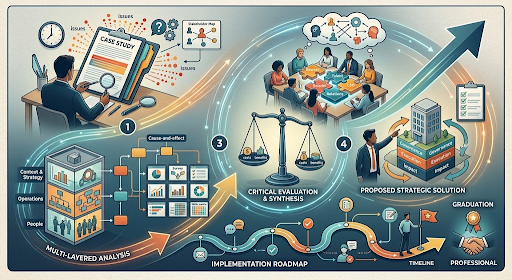
A Step-by-Step Framework for Tackling Any CIPD Level 7 Case Study
Regardless of which unit you are working on, the same five-stage approach keeps your answer focused and aligned to the assessment criteria.
- Decode the brief and learning outcomes. Before you write a single line, map every assessment criterion in the brief to a section of your answer. Level 7 markers grade against the criteria directly, so an eloquent answer that misses a criterion will still lose marks on it.
- Diagnose the organisational scenario. Use a recognised diagnostic tool, PESTLE for external factors, SWOT for internal capability, or a stakeholder map for employee relations problems, to structure your reading of the case facts rather than jumping straight to opinion.
- Anchor theory to the practical dilemma. Select two or three well-established, current frameworks rather than naming ten. Level 7 rewards depth of application over breadth of citation.
- Build evidence-based, feasible recommendations. Recommendations should specify who does what, by when, at what approximate cost or resource, and how success will be measured. Vague suggestions such as improve communication rarely pass at this level.
- Structure, reference and proofread professionally. Use clear headings, a logical flow from diagnosis to recommendation, and consistent Harvard referencing throughout.
How to Structure a 7CO01 Assignment Example and Case Study
7CO01, Work and Working Lives in a Changing Business Environment, tests your ability to read macro-level change, automation, demographic shift, sustainability pressure, hybrid working, globalisation, and translate it into organisational implications.
A strong structure for a 7CO01 assignment example and case study typically runs:
- Context and organisational overview: briefly set the scene of the case organisation and sector.
- External environment scan: apply PESTLE or a similar framework to identify the two or three most material trends affecting the case organisation, rather than covering all six categories superficially.
- Organisational impact analysis: explain specifically how each trend changes workforce planning, skills needs or working practices for this organisation.
- Strategic response and recommendations: propose how people practice should evolve, referencing credible, current sources.
- Conclusion: summarise the strategic case for action.
For example, a case study built around a mid-sized UK manufacturer facing automation pressure might scan technological and demographic trends, show how these threaten the existing skills base, then recommend a phased reskilling and workforce redesign programme rather than a single training intervention.
Strategic Approaches for 7CO02 Assignment Example
7CO02, People Management and Development Strategies for Performance, asks you to connect day-to-day people practice to organisational-level performance outcomes. Case studies here often present an organisation with a performance problem: falling productivity, high turnover in a critical role, or a mismatch between stated strategy and lived employee experience.
A useful lens is the Ability-Motivation-Opportunity (AMO) model, which frames performance as a function of whether employees have the skills, the motivation and the workplace opportunity to perform well. High-performance work system literature is another strong anchor, since it lets you argue for bundles of interconnected practices rather than one-off fixes.
For strategic approaches for a 7CO02 assignment example, structure your answer around: current-state analysis of the people practices in the case, diagnosis of the specific gap against the AMO or a similar model, a coherent package of interventions rather than isolated actions, and a brief evaluation plan showing how impact would be measured over time.
Tackling Legal Scenarios in 7OS01 Assignment Example
7OS01, Advanced Employment Law in Practice, is one of the more literal case study units. Scenarios usually describe a workplace dispute, a dismissal, a discrimination complaint or a contractual disagreement, and ask you to apply UK employment law to the specific facts given.
The IRAC method (Issue, Rule, Application, Conclusion) works well here. Identify the legal issue precisely, state the relevant legal rule or statutory provision, apply that rule to the exact facts of the scenario rather than the law in general, then reach a reasoned conclusion. Two pieces of legislation come up repeatedly when tackling legal scenarios in a 7OS01 assignment example: the Equality Act 2010 and the Employment Rights Act 1996, alongside current guidance published by Acas.
Avoid writing a general employment law essay. Markers want to see the law applied to this employer, this employee and this timeline, with a clear, risk-aware recommendation for how the organisation should proceed.
Working Through a 7CO04 Assignment Example (Business Research in People Practice)
7CO04 differs from the other core units because it assesses your ability to design and justify a research approach rather than to resolve a single dilemma. Case-based prompts here often set out an organisational problem and ask you to propose how you would investigate it.
A solid 7CO04 assignment example structure covers a clearly stated research aim and objectives, justification of your chosen methodology (quantitative, qualitative or mixed methods, and why), a realistic data collection plan appropriate to the organisational context, a discussion of ethical considerations such as informed consent and confidentiality, and an honest acknowledgement of the limitations of your proposed approach.
Students often lose marks here by describing research methods generically instead of justifying why a specific method suits this specific organisational question. Always tie your methodological choices back to the practical constraints and objectives set out in the case.
Where to Find Reliable CIPD Level 7 Assignment Examples and Past Papers
Genuine CIPD level 7 past papers and assessment criteria sit within your training provider’s learner portal, issued directly by your tutor for the specific cohort and unit version you are studying. CIPD periodically updates unit specifications, so an example written against an older assessment criteria set can lead you to structure your answer around outcomes that no longer apply.
Treat any CIPD level 7 assignment examples you find online, including this guide, as a structural reference for how to organise an argument rather than content to copy. Originality is itself a professional competency, assessed directly under the Personal Effectiveness, Ethics and Business Acumen unit, and most centres run submissions through similarity checks.
Once you have a draft, careful referencing matters as much as the argument itself. A quick check of your citations against a proper Harvard referencing guide before submission catches the small errors that otherwise cost easy marks, and reviewing how literature is engaged with critically can sharpen how you weigh sources against each other in a case study answer. If you would rather have a specialist review the structure and evidence base of your draft, our case study writing service and CIPD assignment help team both work directly from your unit’s assessment criteria.
Common Mistakes Students Make in CIPD Level 7 Case Studies
Most marks are lost quietly, not through wrong answers but through habits that undercut an otherwise solid case study. Here are the ones that come up most often:
| Mistake | Why It Hurts Your Grade | How to Fix It |
|---|---|---|
| Describing rather than evaluating | Level 7 markers reward critical judgement, not narrative retelling of the case | For every claim, ask what follows from it and weigh it against an alternative view |
| Overloading with theory | Ten frameworks briefly named look impressive but dilute analysis | Pick two or three theories and apply them in depth to the specific case |
| Generic recommendations | Vague advice such as improve communication is not actionable or case-specific | Specify an owner, timeline, resource and success measure for each recommendation |
| Ignoring the assessment criteria | Strong writing that misses a criterion still fails that criterion | Map every assessment criterion to a labelled section before you start writing |
| Weak or inconsistent referencing | Undermines credibility and can raise academic integrity concerns | Use one referencing style consistently and check it against a reliable guide |
Quick-Reference Checklist for CIPD Level 7 Case Studies
Run through this list before you submit any CIPD level 7 case studies assignment:
- Every assessment criterion is mapped to a section of the answer.
- The case organisation’s context is established clearly in the introduction.
- Two to three frameworks are applied in depth rather than many named superficially.
- Recommendations are specific, resourced and time-bound.
- Evidence is drawn from current, credible sources.
- Harvard referencing is consistent throughout the document.
- The word count sits within the limit specified for the unit.
- The final draft has been proofread for clarity, tone and professional formatting.
Frequently Asked Questions
What is the difference between a CIPD Level 7 case study and a Level 5 case study?
Level 5 case studies generally ask you to apply a single model correctly to a described situation. Level 7 case studies expect critical synthesis of multiple perspectives, evidence-based judgement and board-ready strategic recommendations, reflecting the postgraduate equivalence of the Advanced Diploma.
How long should a CIPD Level 7 case study assignment be?
Word counts vary by unit and training provider, typically between 3,000 and 4,500 words per unit assignment. Always check the specific brief issued by your centre, since exceeding or falling short of the stated limit can affect your grade.
Where can I get genuine 7CO01 assignment examples?
The most reliable source is your own training provider’s learner portal and tutor-issued exemplars, since these reflect the current assessment criteria version for your cohort. Treat examples found elsewhere online as structural guidance rather than content to replicate.
Is 7OS01 compulsory in the CIPD Level 7 Advanced Diploma?
7OS01, Advanced Employment Law in Practice, is typically an optional unit rather than a core one, so its availability depends on your training provider’s unit offering. Check your own programme structure to confirm which optional units apply to you.
What referencing style does CIPD Level 7 require?
CIPD qualifications almost universally require Harvard referencing, with in-text citations and a full reference list. Consistency matters as much as correctness, since a mix of styles across one assignment reads as unpolished.
Can I use the same case study organisation across different units?
Yes, many students use one real or realistic organisation as a consistent case across several units, since it saves research time and builds depth of knowledge. Just make sure each unit’s specific assessment criteria are still fully addressed rather than recycling the same analysis.
How many CIPD Level 7 past papers should I review before starting?
Reviewing two or three past papers or exemplar briefs for your specific unit is usually enough to understand the expected structure and depth, provided they reflect the current assessment criteria. Beyond that, time is better spent applying the framework to your own case.
What is the pass mark for CIPD Level 7 case study assignments?
CIPD Level 7 assignments are typically graded as pass or refer rather than on a percentage scale, based on whether every assessment criterion has been met to the required standard. Meeting each criterion fully matters more than writing at length.
Excel in Your CIPD Level 7 Case Studies
Tackling case studies in the CIPD Level 7 Advanced Diploma comes down to treating every brief as a real strategic problem rather than an academic exercise. Diagnose before you recommend, apply theory with depth rather than breadth, and write every recommendation as though a senior leadership team will actually act on it.
If you want a second pair of expert eyes on your draft, whether that is structuring a 7CO01 case study, strengthening the strategic argument in a 7CO02 assignment, or checking the legal reasoning in a 7OS01 scenario, our Assignment Helper UK specialists can review your work against your exact assessment criteria before you submit.

Olivia Bennett
Olivia Bennett is a trusted academic writer with a sharp eye for structure, argument flow, and citation detail. She helps students handle demanding assignments without losing the meaning of their original brief. Her work at Assignment Helper UK is known for being clear, polished, and built around real academic expectations.