
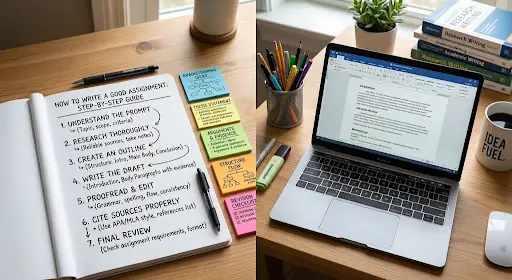
Most students fail to score points for one simple reason. They give a correct answer, but the marker can’t find the points that earn credit, or they answer something different from what was asked.
The marker assesses your work according to a score sheet. Each row carries a share of the marks. A good paper should receive these points clearly. This guide provides step-by-step instructions for writing a good assignment using that grid. You will get a scorecard, a before and after paragraph and a final marks audit.
If you need extra support along the way, a good assignment helper can show you what a well-matched answer looks like.
The Marker’s View: What Actually Earns Marks
A marker has to read multiple papers in a given week. They look for specific indicators for each row. If they are easy to find, you score; if you have buried them, you risk losing valuable marks. Your goal is to make every point clear and easy to find.
There is a fixed marking grid used by the markers which has certain criteria. These criteria are understanding, analysis, referencing, and organisation. Every row in the grid corresponds to a certain percentage of marks.
Step 1: Turn the Marking Criteria into a Scorecard
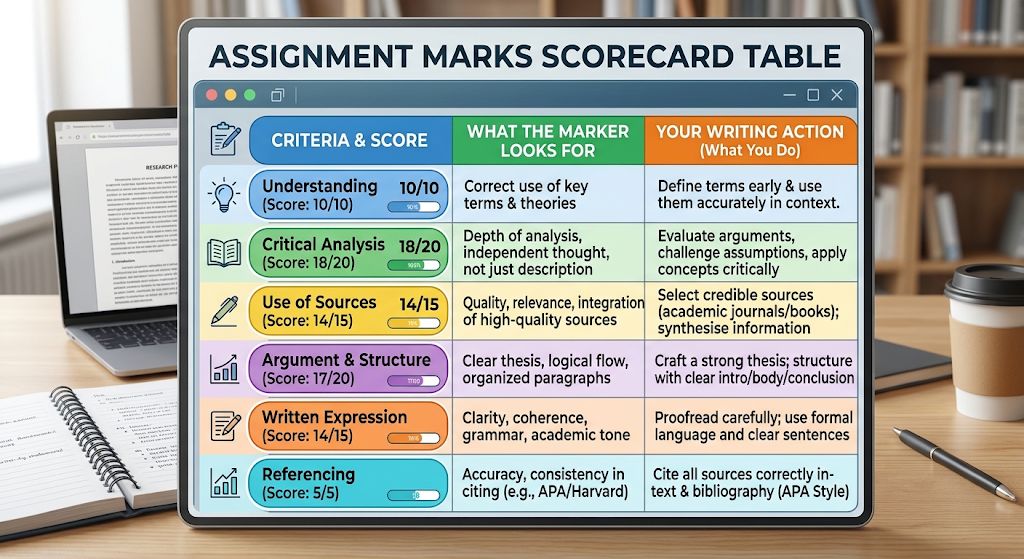
First, do this before examining any source. Get your brief. Look for the marking criteria. Enter its contents into the table shown below.
| Typical Criterion | What the Marker Looks For | What You Do |
| Understanding | Correct use of key terms and theory | Define terms early and use them in context |
| Critical analysis | Judgement, not description | Compare views and say which is stronger |
| Use of sources | Credible and relevant evidence | Back every main claim with a source |
| Structure | A logical flow of ideas | Use clear topic sentences and links |
| Referencing | One consistent style | Cite as you write |
| Written style | Clear and formal language | Use short sentences and exact words |
Rank each row by marks. Assign the row with the highest marks the most time and words. More specifically, if a row is worthy of 40% of the entire grade, one should spend around 40% of the time on it. Yet, students often make a mistake in this case. They spend most of their time describing this part since it appears to be the easiest.
Step 2: Write Your Answer in One Sentence
Before examining the sources, write one sentence that answers your assignment. Write it in this form: This assignment argues that X because of Y and Z.
Your sentence will change as you research but will give your assignment direction and the structure for each essay paragraph. If any of the paragraphs is not connected to this statement, cut it.
You can do a simple check. Ask a friend to look at your sentence and see whether the key arguments in it are clear enough.
Step 3: Build an Evidence Bank Before You Draft
It is crucial to collect sources purposefully rather than randomly. For this reason, it is recommended to create a small evidence bank, which could include five columns.
1. Claim
2. Source with year
3. Page
4. Short information presented in your own words
5. Criterion supported
The aim is to have at least two or three sources for each point. One should definitely find peer-reviewed articles, books and reports.
Students of Liverpool John Moores University are advised that using lecture notes is not enough. There are a lot of books on various subjects in the university library, so students have wide access to various sources of information.
As for Oxford Brookes University, it provides students with information about how to plan research and manage their time.
Step 4: Draft the Middle First
Here is a habit which many students find surprising. Write the body first before the introduction.
The reason is simple: your introduction promises what your body writes about. You can’t promise something credible until your body is ready.
Make your strongest point first. It gives the necessary momentum. The procedure is very simple:
- Set a timer for 25 minutes.
- Write non-stop.
- Leave some gaps, such as [add source], and continue.
- Take a 5-minute break.
- Repeat.
Keep one thought in every paragraph, and any reader should understand what the message is by reading the first line of your paragraph.
Step 5: Write the Introduction and Conclusion Last
The body is finally completed. Now it’s time to write the frame. To write an introduction, follow these four simple steps:
- Write one statement providing some background information.
- Write one statement explaining the core problem.
- Include your answer from step 2.
- Mention the structure of the text.
When writing a conclusion, you should follow these three steps:
- Restate your answer in other words.
- Summarise your key ideas.
- Provide some insight or predictions.
You shouldn’t provide any proof in conclusions. Remember that both parts shouldn’t contain more than 10% of the total number of words.
Step 6: Upgrade Weak Paragraphs
Most weak paragraphs share one flaw. They describe but lack judgment. Below is an example cited in a business course.
Before:
The remote work environment benefits organisations. Many organisations are adopting such a strategy. It saves money, plus employees enjoy working remotely.
The text doesn’t include references or an impressive analysis. So, the marker has nothing to mark in the paragraph.
After:
Remote working has the potential to reduce office costs (Author, Year). Funds saved from rent and utility bills may be used for employee training. However, it is highlighted that there are risks concerning team collaboration (Author, Year). This implies that the benefits might depend on how effective managers are.
The second version explains two more things. Firstly, it provides an argument. Secondly, it includes evidence and alternatives. In this way, the author provides his evaluation.
This formula should be used for any weak paragraph. A source must be added, the limit or opposite opinion must be presented, and a statement which starts with “it suggests’’.
Step 7: Edit Backwards
While proofreading, don’t edit the paper from beginning to end. Your eyes will naturally skip the mistakes you already know. Instead, use a reverse outline to create a short summary of each paragraph, and check whether those summaries provide clarity. If not, check the paragraphs again to clarify the intended meaning.
Start from the end of the document and read paragraphs backwards. This method helps you detect any weak points in the paper and fix them. If you have the time, work on the paper for a day or two before proofreading it again.
It might be helpful to reach out to a proofreading assignment helper and ask them to check your paper for clarity and grammar before submitting it.
Step 8: Run a Final Marks Audit
Go back to your checklist from Step 1. Mark each row only when you point to proof.
Understanding: Are terms properly defined and used?
Analysis: Does the section conclude?
Sources: Are all significant claims backed by proof?
Structure: Does every piece of writing have a clear title?
Referencing: Are all the citations in the text referenced in reference lists?
Style: Are written claims short and formal?
Formatting: Does the number of words, font, margins and cover match the requirements?
If a row doesn’t have proofs, fix it now. This audit of five minutes guarantees more points than an hour spent on writing.

Use AI and Online Tools Within the Rules
Currently, many universities in the UK have published policies on generative AI. The policy varies based on the module. While some modules permit the use of AI tools for brainstorming or grammar-checking purposes, others don’t allow them.
If you are unsure of what your module entails, make sure to refer to your module handbook or consult your professor before proceeding with your work. It is important not to submit a text generated by AI as your own. You can read our article on the role of ethics in university assignments for more information on the topic.
Extra Tips for MBA Students
MBA evaluators expect you to relate theory to a real organisation. Select any company and use real data. Take one or two frameworks and work on them in detail. PESTLE and Porter’s Five Forces are some of the frameworks. You should apply depth rather than listing six frameworks. When making your recommendations, ensure you rank them based on priority and cost.
Postgraduate students often look for assignments related to an MBA. A good service is expected to show how the analysis, evidence, and recommendations are linked. Read about how our MBA assignment help before making any final decision.
When an Assignment Helper Makes Sense
The above steps work well. However, life can be busy. You could have three deadlines to meet in one week. You might also work night shifts. For some, English is a second language.
In such situations, a good assignment helper can save your semester. Make sure you find someone who offers reasonable rates, skilled writers, plagiarism-checking, and a good revision policy. Be careful of any guarantees of a particular grade.
Use the paper to learn. Look at its structure, see what sources are used, and repeat the same approach in your next assignment.
Conclusion
It is worthwhile to note that doing an assignment doesn’t mean creating more content. So, the first thing you should do is understand the marking criteria, state an answer, and collect evidence.
It is recommended to complete the body of the text before providing an introduction or conclusion, and to revise from the end. If you run out of time or struggle with a topic, consider asking an expert for assistance and getting know-how.
FAQs
How to write a good assignment step-by-step?
Begin with the marking criteria for the assignment and use them for scoring. Provide the answer in one sentence. Create an evidence bank. Write the body of the assignment first before starting on the intro and conclusion. Then edit the paper in reverse and do the final scoring.
Should I write the introduction first?
No. A great number of students write the intro last because they know what their body says by the moment. If drafting the introduction makes it easier for you to write the assignment, do that.
How many sources do I need?
This may be indicated in your brief or module guide. In the absence of information from your professor, make sure your main arguments are backed up by sufficient evidence. A good rule of thumb is to find two or three sources for each point.
Can an assignment helper help me improve my grades?
A reliable assignment helper doesn’t just help you score high but shows you the way to research, structure and reference your work. You learn from the template and then apply the ideas and methods you learnt.
Where may I locate reliable MBA assignment help?
Seek out writers with postgraduate degrees, reasonable pricing, and assurance of plagiarism-free content. Look at the revision policy. Do not use services that provide guarantees for grades.