
Table of Contents
- Olivia Bennett
- No Comments
In the highly competitive world of British university studies, simply presenting factual data in an essay will seldom earn you an A* grade. Good academic writing requires a degree of engagement from the audience that turns the reader from a passive viewer into an active part of the process.
Whenever you begin to write an essay, a research paper, or even a dissertation, what you seek to do primarily is to convince the person who is assessing your work that not only is your logic sound, but your argument is absolutely incontestable.
The way experienced academics and authors do this is through using some classical literature techniques that give structure, dynamics, and rhythm to their writing. Understanding the hypophora meaning can literally turn your essay writing around.
It is common for a lot of students pursuing their degrees at the undergraduate or postgraduate levels in the United Kingdom to experience difficulties in retaining a robust voice throughout the course of their essays.
This often results in dull and boring summarisation of the literature, resulting in criticism of their work based on the fact that they lack depth or the ability to demonstrate their own personal views.
With the use of specific rhetoric, you can overcome this difficulty and bring life and authority to your writing. Understanding the definition of hypophora can help you accomplish this, especially considering the fact that the technique helps mimic natural modes of discourse.
Understanding Hypophora Meaning
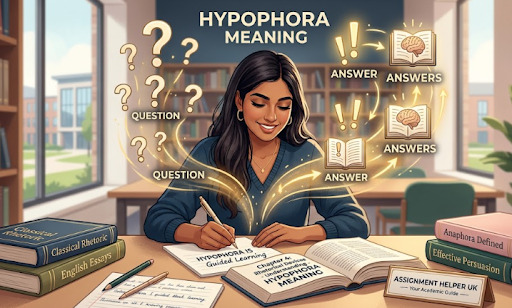
In order to understand the significance of this figure of speech, it is essential to analyse its basic notions in order to learn the very essence of this stylistic device. To put it simply, it involves a method when the speaker raises a certain question and provides an immediate answer.
It combines two elements: questioning and answering, thus making it different from all other questions that do not have answers to them immediately. In contrast to the latter, here the speaker takes the reins into his/her own hands and formulates the answer, trying to make it coincide with his/her main thesis or idea as much as possible.
The history of this term goes way back to the ancient Greeks, who valued rhetoric, legal reasoning, and philosophy more than any other culture. Its linguistic origins involve a combination of the Greek prefix, meaning ‘under’ or ‘before,’ with a Greek verb, meaning ‘to carry’ or ‘to put forward.’
This gives the exact essence of the rhetorical function of hypophora, namely putting forward a question before presenting an answer under it. When you study what is hypophora, you will understand it as a preemptive rhetorical move that enables you to address any potential objections in your audience even before they appear in their minds.
As a student, being able to use hypophora effectively entails acquiring the skill of controlling the pace of your essay, making sure that the reader follows the line you have set.
A Detailed Breakdown of the Hypophora Definition
Upon examining any ordinary dictionary, the hypophora definition can be seen in terms of a figure of speech where the author introduces an objection or a question and provides the answer to it.
According to current linguistic research, this stylistic device can be seen as an interactive discourse relation as a substitute way of organising information in spoken language.
Hypophora makes it possible for the author to pretend that he/she interacts with the readers through conversation, thus introducing some variation to the block-like expository texts.
The beauty of the technique is in the simplicity of its implementation, as there are no sophisticated syntactic structures involved; only two elements are present: a question and an answer.
For the purpose of developing further definitions about the term in question, it should be noted that contemporary linguistics distinguishes two major structural types of hypophora, which are called cohesive hypophora and disjointed hypophora.
The cohesive versions can be characterised by placing the question and the answer within one sentence or even close clauses in order to generate a spark of clarity and continue moving further in the process of reading.
As for disjointed versions, they may comprise a question placed at the end of a transitional paragraph followed by several paragraphs devoted to providing a detailed answer to that question in the form of a multi-level answer, which makes up the core of the whole passage.
Regardless of the specific structural variation you choose to employ in your assignments, the underlying principle remains identical, as the author must always supply the definitive answer to ensure the device functions correctly.
Hypophora vs Rhetorical Question: Resolving the Student Dilemma
Another mistake that comes up very often among university students is the misconception about the difference between the rhetorical question and hypophora. There is nothing surprising in the assumption of many university students regarding the fact that these two rhetorical devices may be regarded as interchangeable because of the presence of questions.
However, one should always differentiate between these two concepts to prevent any possible issues with academic writing. In spite of the similarity of their structures in terms of the grammatical nature of these rhetorical devices, their impact on the reader is completely different.
The rhetorical question is posed for the purpose of receiving a response from the author themselves that cannot be given because the answer would be too obvious for any person who has read the text.
For instance, when asking whether human beings need fresh air to live, there will be no further scientific justification because the author expects their audience to know that the answer is obvious anyway.
On the other hand, the hypophora requires that the author explicitly provides the answers without leaving anything to implication at all. An excessive use of rhetorical questions in a university task may frustrate a lecturer, especially if it appears that you are attempting to escape from providing evidence for your arguments.
Deploying the question-and-answer format of this classical device, however, shows that you are actively driving the argument forward and taking full responsibility for proving your assertions.
Expanding Your Rhetorical Toolkit: Related Figures of Speech
To truly elevate your academic writing, it is highly beneficial to understand how this technique interacts with a broader family of classical devices. While mastering the core concept is essential, students frequently cross paths with anthypophora, which specifically refers to a subset of this device where a writer pre-emptively counters a hypothetical opponent’s objection, or procatalepsis, an overarching strategy where an objection is anticipated and answered before an adversary even has the chance to speak.
In addition, you can also find instances of epiplexis, which is a literary tool where questions are posed without seeking answers or proofs, but in order to scold, mourn, or reprove the listeners because of a certain failure on their part. This is very different from anaphora, wherein there is a purposeful repetition of a word or phrase at the beginning of each succeeding clause.
Lastly, it is worth noting that some individuals mistakenly search for the term “hyperphora,” which is almost always a spelling error or a cognitive conflation of “hypophora” and “hyperbole”; keeping these distinct terms clear in your mind ensures that your stylistic choices remain entirely accurate, precise, and professional in every essay you submit.
Why Authors Deploy Hypophora
It must be stressed that writers, politicians, and scholars resort to the technique of hypophora not by accident but deliberately owing to the powerful psychological effect that it exerts upon an audience.
Indeed, when faced with the symbol of question marks, human brains involuntarily pause in order to ponder about possible answers, though for no more than several fractions of seconds.
The very split second when a reader thinks about an answer is priceless for any writer, who can make use of this split second to break the inertia of the audience and grab the attention of readers completely. And as soon as a question mark emerges, the writer gives out the answer in order to satisfy curiosity and force readers to adopt a certain viewpoint.
In addition, this method acts as an outstanding medium for adding transitions and arranging complicated data without turning the reader off. Transitioning from a general discussion to a detailed example is abrupt and disjointed.
However, with a perfectly timed question, you are able to prepare the reader for this switch of perspective by making the inclusion of new information seem natural and even obvious.
In addition, you are able to raise and answer any criticism in such a way as to disarm the reader and keep them on your side throughout the piece. You can make sure the reader has no reason to doubt what you say because you ask the same questions they would be skeptical about.
Famous Historical and Literary Hypophora Examples
In order to understand how it works in high-level discourse, we can examine some classic hypophora examples that come from literature or from political oratory. The renowned Shakespeare is a great example of one of the authors who often employed this literary device.
As the creator of numerous characters on stage, he provided them with the opportunity to find the rationale behind their internal struggles by using hypophora. For instance, in his drama Henry IV, Falstaff gives an impressive speech about the notion of military honour, asking questions such as what honour is, whether it can cure a broken leg, or relieve a wounded soldier from sorrow.
Each question was answered in the affirmative and ended up with the conclusion that honor is merely a word. In addition to being one of the main devices used in the theatre industry, many of the greatest political speeches in British history use this very format in times when the country is faced with serious threats to its safety and existence.
At the height of the Second World War, for instance, the then prime minister, Winston Churchill, spoke to the people in the parliament and used this rhetorical device. He began by asking what their strategy was, answering himself by saying that it was a fight against all enemies on land, at sea, and in the air. He then asked again what their objective was, replying that their aim was victory.
Modern Hypophora Examples in Corporate Branding and Speeches
You do not need to look for this literary technique in ancient writings, since it is quite common in modern times as well. You can find many examples around you in today’s society from the commercial advertisements on TV to internet-based marketing campaigns.
The advertisers know very well that people have a tendency to be skeptical about direct marketing approaches and, therefore, utilise hypophora to address this skepticism.
For instance, a renowned technological firm can run its advertisement campaign using a billboard questioning the difference between its latest smartphone and earlier products, only to follow up with a striking statement asserting that the difference lies in its completely revamped design for being sustainable.
In addition to corporate marketing, contemporary eco-activists and popular orators utilise hypophora frequently in order to bring scientific statistics within reach of the average person.
At viral informative events or international summits, for example, an orator may display a complicated graph of carbon emissions and ask the audience if it denotes an unmitigated disaster.
The orator then follows it up with the assertion that it does not, as long as we introduce local environmental technologies promptly. This strategy keeps the audience from getting lost in data by providing them with a concrete plan of action with no room left for doubt or despair.
A Step-by-Step Method to Implement Hypophora in Assignments
The process of incorporating this technique in your university essays calls for delicacy and understanding of the reason behind it since misuse will make your essay unnecessarily dramatic. Just like it is essential to know how many references are adequate, similarly a balance of hypophora is important as well.
The first stage in making good use of hypophora is finding the right time during your essay writing when you would face an oppositional stance towards your argument or would need a change of mind in order to prove yourself.
Rather than making a conventional and boring introduction for your following argument, you will ask a very complicated question and show your awareness of all the problems that lie within your subject matter.
The second part entails ensuring that your answer to the question asked comes swiftly, confidently, and convincingly with scholarly sources backing up your argument. The posed question should never be made to hang on in several paragraphs without being answered, as such an approach goes against the construction of the technique and makes it a narrative.
You are required to begin answering the posed question in the next sentence with confidence and objectivity to assert control over the subject matter at hand. This will provide direction and a sense of purpose to your entire essay since all the sentences within it will be seen as contributing to a specific proposition. This is a major step for not failing your assignment.
Common Errors Students Commit with Hypophora
Even though acquiring knowledge about the hypophora meaning would greatly contribute to improving your writing skills, it is crucial for you to understand the mistakes that students tend to make while using this technique in their academic essays.
The first mistake that arises from abusing this rhetorical strategy is making use of too much hypophora in one essay. When hypophora becomes the primary way of asking questions, it immediately loses all its effectiveness, and your essay will start looking like some kind of a boring script rather than an academic paper.
When the reader encounters hypophora questions every other three paragraphs, he will certainly become irritated with it. Yet another common error involves posing poor questions that do not contribute anything to the underlying discourse.
Forming a question whose answer would be trivial and contain only a single word is a waste of time and a sure way to create poor-quality work. Questions need to address the main issues of the research topic through raising academic disputes, discussing methodology, or conflicting interpretations of theory.
Finally, remember to provide information and answers that directly respond to your question. Raising an interesting question and answering an irrelevant one may confuse your assessor.
Frequently Asked Questions
Is hypophora suitable for formal scientific and research papers?
The device is effective in formal scientific writing when used sparingly and objectively. It is best in discussion or introduction sections to frame research problems or literature gaps, engaging readers with analyses of complex data while maintaining the formal tone needed for academic journals.
What is the main structural difference between hypophora and anthypophora?
Anthypophora is a rhetorical device anticipating and rebutting an adversary’s argument, often linked to hypophora, which encompasses any self-answered question. For university assignments, prioritise answering your own queries, as this showcases your rhetorical skills, a key assessment criterion.
Can a student use hypophora in an introductory paragraph?
Using a provocative question in an essay’s introduction captures examiner attention and sets an authoritative tone. This question highlights the broader dilemma, with the immediate answer previewing the thesis. It demonstrates the essay’s analytical focus and intent to solve a complex academic problem.
How does hypophora help in addressing counterarguments?
The figure of speech empowers writers to address counter-arguments effectively by preemptively posing objections as questions. Following these with strong, evidence-based refutations showcases critical thinking and intellectual maturity, demonstrating that a thesis can endure rigorous scholarly analysis.
Reach Your Academic Success with Assignment Helper UK
Thus, a complete comprehension of the hypophora meaning equips you with an incredibly powerful weapon that helps to strengthen the structure, persuasiveness, and clarity of your university essays.
Through stepping out of merely describing something in order to take your audience on a journey of question-and-answer dialogues, you prove yourself as one of those outstanding learners who stand out against others due to their advanced ability to think critically.
It should be borne in mind that any effective academic piece of writing does not merely involve the presentation of vast amounts of knowledge but its compelling delivery.
Should you find that you are becoming frustrated with the complexities involved in classical rhetoric or simply cannot get started developing an academic voice in your essays, there is no need for you to feel that you must undertake this journey alone.
With the help of our expert writers at Assignment Helper UK, we can guide you through your essay writing, literary analysis, or structural editing, providing assistance with all the necessary elements of composition to give you the grades you require.
From crafting your arguments to ensuring that your work is grammatically impeccable and meets all the criteria of a UK university standard, we can help you achieve great things academically.

Olivia Bennett
Olivia Bennett is a trusted academic writer with a sharp eye for structure, argument flow, and citation detail. She helps students handle demanding assignments without losing the meaning of their original brief. Her work at Assignment Helper UK is known for being clear, polished, and built around real academic expectations.